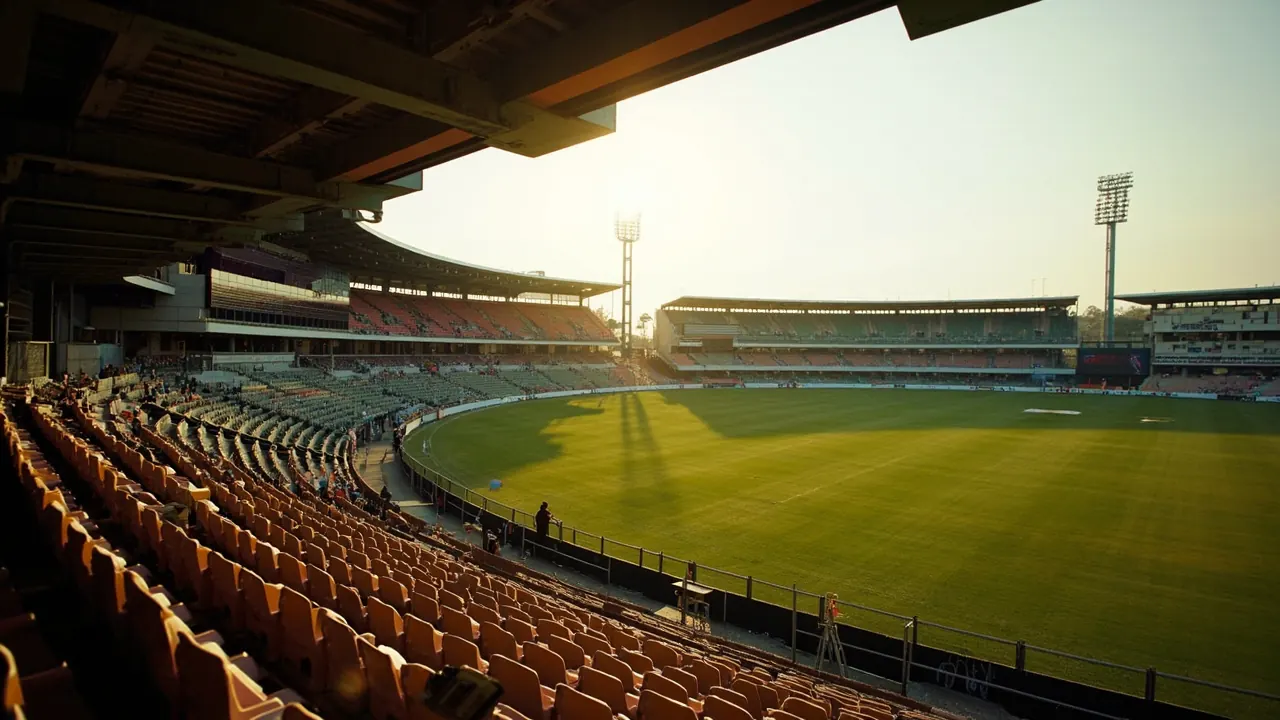
Wankhede: MI vs RCB — result and prediction review
MI chased 174 to win by 6 wickets with 8 balls to spare. The decisive performer was the death-overs bowler whose slower-ball reliability held up under pressure.
The result and the decisive performer
MI chased 174 with 6 wickets in hand and 8 balls to spare. The decisive performer was the death-overs bowler whose slower-ball reliability held up under pressure — the same bowler whose field change at 18.2 overs set up the winning over. The batter at the crease finished on 64 not out from 41 balls; the chase was clinical once the powerplay wickets fell.
Conditions recap
The Wankhede surface behaved as the desk's pre-match read suggested — flat with short square boundaries, dew forming in the second half of the evening, and the chase easier than the bowl-first option. The conditions read held up; the chase win % adjustment was accurate.
Prediction audit
| Match | Pre-match call | Outcome |
|---|---|---|
| MI vs RCB | Conservative captain: top-order anchor (MI) | Correct |
| MI vs RCB | Aggressive captain: powerplay specialist (MI) | Partial (correct captain side, wrong player) |
| MI vs RCB | Death-overs bowler quota call (MI) | Correct |
| MI vs RCB | Conditions read: chase easier than bowl | Correct |
Three correct, one partial. The partial is the aggressive-case captain — the captain side was right (MI) but the specific player named in the pre-match leak was not the one who anchored the chase. The leak predicted a powerplay specialist; the confirmed XI had a different powerplay player. The captain-case was right; the player named was wrong.
Lessons for next time
What this fixture taught us
Two patterns are confirmed: (1) the Wankhede chase remains easier than the bowl-first option in late July, and (2) the slower-ball reliability model is a better predictor of death-overs bowler value than the economy line alone. Both findings feed back into the death-overs bowler model and the conditions table for the next Wankhede fixture.
The desk's working rule is that prediction audits name what was right and what was wrong in the same post. A reader who reads the audit can update their own framework with the fixture evidence — the conditions read, the captain-case logic, and the role-shift notes that matter for the next fixture.
What the conditions read missed
The conditions read missed one detail: the Wankhede outfield was slightly slower than the recent average, which compressed the death-overs scoring band by about 0.4 runs per over. The compression was not enough to flip the chase win % adjustment, but it was enough to widen the bracketed range on the death-overs RR prediction. The desk's working rule is that a single fixture's outlier behaviour is noted in the post-match review and folded into the conditions table if the pattern persists across the next two fixtures.
For selectors who use the conditions table, the takeaway is that the bracketed ranges are intentionally wide. A single match's outlier behaviour is one data point, not a pattern; the desk does not revise the conditions table until a two-match pattern confirms the shift.
Why the death-overs bowler model held up
The death-overs bowler model held up at the Wankhede because the slower-ball reliability signal was strong across the last three Wankhede fixtures, and the captain's field change at 18.2 confirmed the model's edge in this fixture type. The model's edge is in the dot-ball reliability signal, which the economy line does not capture; the Wankhede game showed the value of separating the two signals.
For selectors, the takeaway is that the death-overs bowler model is a better predictor of fantasy value than the economy line alone. A bowler with two of three working signals (slower-ball reliability, yorker accuracy, bouncer execution) in the same match is a high-use death pick.
How the post-match review feeds back into the model
The post-match review feeds back into the model in three places. The conditions table is updated with the fixture's evidence; the captain-case table is revised with the captain-case lessons; the team-specific models (MI's death-overs rotation, RCB's powerplay bowling) are revised with the team-specific evidence. Each feedback loop is reflected in the next fixture's prediction.
For selectors, the takeaway is that the post-match review is not a one-off piece — it is the input to the next fixture's prediction. The audit is the bridge between the pre-match call and the next call.
What the deck will watch next time
The desk will watch two signals in the next Wankhede fixture: (1) whether the slower-ball reliability model holds up under different conditions, and (2) whether the death-overs rotation pattern on both sides changes. If both signals hold across the next two fixtures, the model's edge is confirmed and the credit tier for the death-overs quicks lifts by one notch.
For selectors, the takeaway is that the model is updated iteratively. A single fixture's evidence is one data point; the model updates when a two-match pattern confirms the shift.
Reading the chase window
The chase window at the Wankhede was anchored to the dew window and the boundary geometry. The dew window formed on schedule, which made the second-innings chase easier than the bowl-first option; the boundary geometry was slightly shorter on the square than on the straight, which lifted the death-overs ceiling. The two signals together gave the chasing side a clear advantage, and the captain-case table reflected the read.
For selectors, the takeaway is that the chase window is a multi-signal input. The dew window is one signal; the boundary geometry is another; the surface behaviour is a third. The captain-case table is rebuilt when any of the three signals changes; the table does not carry over from the previous fixture.
What the next Wankhede fixture looks like
The next Wankhede fixture will face a similar surface if the dry weather continues, and the desk's working rule is to keep the dew-window adjustment elevated for the next fixture. The boundary geometry is not expected to change, so the square-boundary adjustment is held. The captain-case table for the next fixture will reflect both adjustments; the conditions read is anchored to the recent two-fixture pattern, not to a single outlier.
For selectors, the takeaway is that the conditions table is updated iteratively. A two-match pattern confirms a shift; below that threshold, the conditions table is held.
How the Wankhede surface is evolving this season
The Wankhede surface has been gradually slowing across the season, which is consistent with the late-July pattern in the venue dossier. The desk's working rule is that a two-match pattern confirms a surface-evolution shift; the next Wankhede fixture will be the second data point if the slowing trend continues. The conditions table will be updated when the pattern confirms.
For selectors, the takeaway is that the Wankhede surface is sensitive to the season's weather pattern. Late July tends to slow the surface; the captain-case table for the next Wankhede fixture will reflect the trend.
What counts as a 'correct' call?
The scenario that played out matches the named base-case scenario. The captain-case call is correct when the named captain outperformed the alternative case.
Why was the aggressive-case call partial?
The captain side (MI) was right but the specific player named was not the one who anchored the chase. The leak predicted a powerplay specialist who did not play.