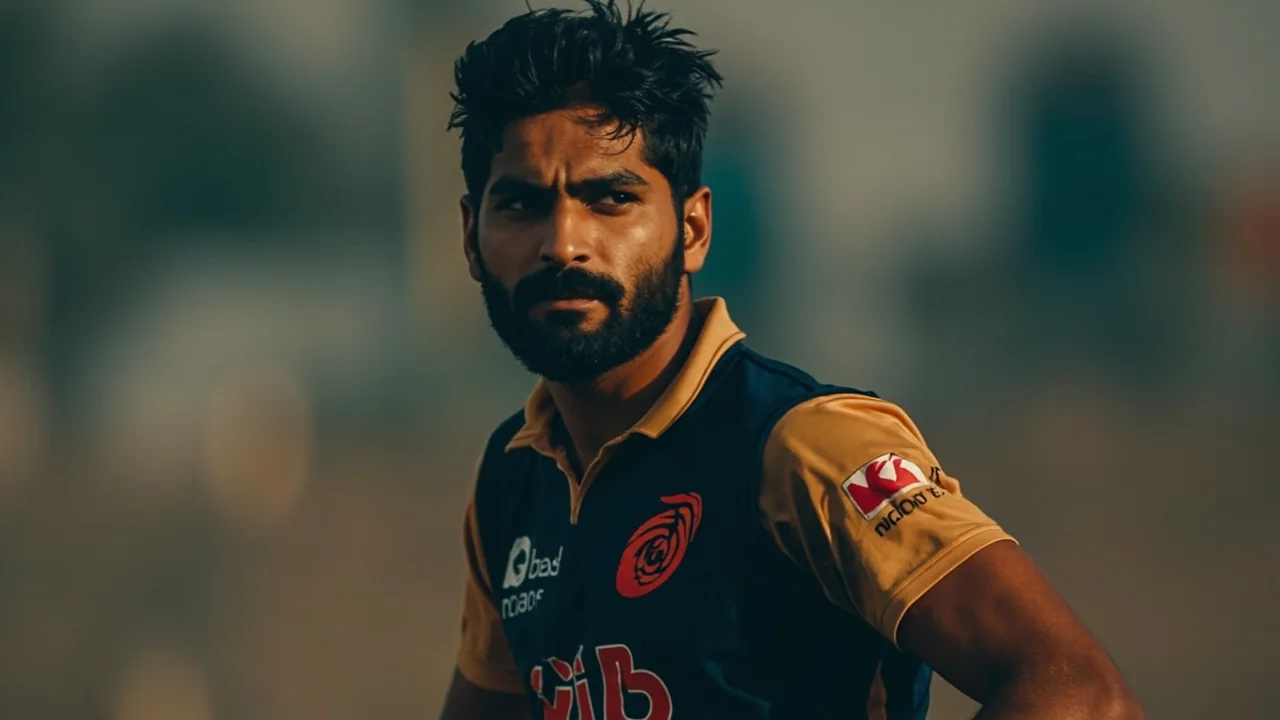
On 19 November 2025, The Times of India published an exclusive Q&A with India swing bowler Bhuvneshwar Kumar. The headline framing was a single line about fast bowlers and machines. The body of the interview was broader: workload management for senior all-format players, the comeback timeline from a side strain, the Ranji and Duleep Trophy route back to the Indian Test team, the T20-versus-first-class fork he expects to define the next generation, and the launch of his Cricketgiri app. Read back as a dated record, the interview is the cleanest window into how a 35-year-old swing bowler with 294 international wickets frames the body, the formats, and the domestic circuit that surrounds his career in late 2025.
The opening line did the work the headline needed it to do. "Wo machine toh nahi hai, machine ke bhi aap part change kar sakte ho but human body waise work nahi karti." The sentence translates plainly: a fast bowler is not a machine, machines let you replace parts but the human body does not work that way. The point of the line was not a slogan. The point was that workload management is not a luxury. For a fast bowler who plays all three formats for India and an IPL franchise, the body is the tool, and the tool degrades under repeated loading faster than a batting load degrades. The argument Kumar made in the interview, and the argument that mattered for fantasy selectors reading his role back into IPL 2026 and the 2025-26 Ranji Trophy, was that workload rules apply to all-format bowlers, not to Under-19 cricketers or to domestic players whose season runs six months followed by an off-season. The scope of the rule was inside the interview, and the scope was the working elite.
The quote and what it actually argued
The machine line worked because Kumar placed it next to a concrete claim. Fast bowling loads the body more than batting. A bowler at 90 percent fitness is functionally 10 percent short, because fast bowling demands more than 100 percent to deliver the speeds, the lengths, and the workloads the role requires. The pairing was deliberate: a fast bowler does not have the buffer a batter has. A batter at 80 percent can still bat; a fast bowler at 80 percent cannot bowl at match intensity without the body taking the strain. The quote was the framing. The body of the interview was the operational consequence.
Read back as a dated record, the operational consequence for fantasy selectors is that workload announcements about senior fast bowlers should be read at face value. A senior India fast bowler told the press he is being rested is, in his own framing, a player whose body needs rest to keep delivering at the level the role demands. A batter told the same thing carries a different operational meaning. The workload rule does not generalise cleanly across roles. For selectors tracking IPL 2026 auction lists and Ranji Trophy availability ahead of the 2025-26 season, the distinction between a workload-managed fast bowler and a workload-managed batter is the same distinction Kumar drew in the interview: the body's tolerance for the load is different, and the recovery windows have to be calibrated to that difference.
The Meerut lineage and the swing-over-pace identity
The interview returned more than once to where Kumar learned to bowl. He is from Meerut, in Uttar Pradesh, and he named Praveen Kumar as the most renowned ustaad of the Meerut fast-bowling gharana. The lineage framing was not ornamental. It explained the technical identity Kumar has carried through 21 Tests, 121 ODIs, and 87 T20Is for India, and through the IPL career that took him to Royal Challengers Bengaluru for the 2025 season. The Meerut school bowls in the 130 kph range and hits a fuller length. The skill is swing, not raw pace. The skill is the kind that ages more slowly than express pace does, because the body's load is lower per delivery and the craft is built on control rather than on speed.
The Meerut craft is built on swing, not on raw pace
Kumar's identity through 294 international wickets is the fuller length and the seam position that brings the ball back into the right-hander. The body load per delivery is lower than an 145 kph operator, but the workload across a season still compounds, and that is the point of his interview.
For fantasy selectors, the lineage framing matters because it predicts the kind of role Kumar will hold into his late thirties. A swing bowler who hits a fuller length has a longer role shelf than an express-pace bowler whose speeds drop with age. RCB used that identity to good effect in IPL 2025. The 17 wickets Kumar took in the season, on the way to Royal Challengers Bengaluru ending their 18-year IPL title drought, were wickets taken on control rather than on speed. The reading the interview supports, read back at this distance, is that the RCB role in IPL 2025 was an extension of the Meerut craft rather than a reinvention of it.
Workload rules: who they apply to, and who they do not
The most concrete policy statement in the interview was on the scope of workload management. Kumar's position was that workload rules are not a tool for Under-19 players and not a tool for the bulk of the domestic circuit. They apply to the small group of fast bowlers who represent India in all three formats across the year and stack an IPL season on top. The argument was that domestic cricketers get enough rest between the six-month season and the off-season, and that workload rules would simply remove playing opportunities from players whose bodies do not need the protection. The frame was: protect the elite, do not over-protect the developmental pool.
The frame matters because it gives selectors a way to read squad announcements that include workload notes. A workload note attached to a senior India fast bowler playing IPL and international cricket across the calendar is a different signal than the same note attached to a domestic player whose season has natural breaks. For the senior player, the note is operational. For the developmental player, the note would be a mistaken reading of the body's needs. Reading the interview back, the distinction is part of how Kumar explained why the policy is targeted. For a selector scanning Ranji Trophy squads and India A lists in late 2025, the implication is that workload notes should be weighted by the player's representative load rather than read uniformly.
Selectors tracking the 2025-26 Ranji Trophy will also want to track whether the workload note Kumar drew in the interview holds up against the season. The first block of Ranji fixtures began in late October 2025, after the interview window closed, and the season runs through February 2026 with a break for white-ball commitments. The structure already includes rest periods. For senior fast bowlers returning from injury lay-offs, the workload question is whether the selectors and the franchise agree on a playing count or a workload budget for the season, not whether the season itself is too dense.
The comeback arc and the 90 percent threshold
Kumar used the interview to push back against a frame the press had been running on fast-bowler comebacks. The frame was that bowlers take longer to come back from injury because of a mental block. Kumar's response was direct: there is no mental block. A bowler at 90 percent fitness is genuinely 10 percent short. The reason the comeback timeline reads long is that fast bowling demands more than 100 percent fitness to perform at match intensity, and a bowler who has not crossed that line is not fit enough to play. The reading is that the comeback takes as long as it takes for the body to clear the threshold, and the press should stop framing the gap as a confidence issue.
The comeback framing matters for selectors because it tells them how to read return-to-play announcements. A fast bowler announced as back in the squad is a bowler who has cleared the threshold, not a bowler who has talked his way into the side. A fast bowler still listed as recovering is at the threshold or below it, regardless of how he sounds in interview. The interview was, in effect, a public brief on the operational language the press uses for fast-bowler injury returns. For selectors tracking India squad announcements through the 2025-26 home season and the IPL 2026 auction, the brief is a way to read return-to-play notes at face value. The 90 percent threshold is the operational floor.
The Ranji route: why first-class cricket still matters
The interview's strongest forward-looking statement was on the Ranji and Duleep Trophy as the route to the Indian Test team. Kumar's position was unambiguous: any player who wants to play Test cricket for India has to play first-class cricket. T20 leagues do not substitute for that requirement. The argument was that the volume of red-ball cricket a selector needs to see in a player cannot be generated by T20 appearances. A T20 innings is twenty overs. A first-class innings can run five sessions. The formats are not interchangeable. The Test team is selected from players who have built a first-class body of work, and the first-class body of work has to be visible in domestic cricket for the selector to evaluate it.
For selectors reading the interview back, the Ranji route framing does two jobs. First, it tells them that a young fast bowler who skips Ranji Trophy to play T20 leagues will not be in the Test team conversation, regardless of how well the T20 leagues go. Second, it tells them that a senior fast bowler returning from injury should be tracked through Ranji Trophy and Duleep Trophy appearances rather than T20 leagues, because the Test team is the destination the format was designed to feed. The 2025-26 Ranji Trophy, with its early-season block running through November and December 2025, is the natural read for selectors who want to see how a returning fast bowler looks at red-ball intensity. For per-player workload tracking across formats and venues, the player assessments on the desk's player workload coverage track role changes, bowling allocation, and the format-specific fitness windows that Kumar's interview made the topic of the week.
The T20 fork and the conscious choice ahead
The interview also named the structural fork Kumar sees in front of the next generation. His prediction was that an increasing number of players will make a conscious choice to play only T20s, and that the choice will be a legitimate career path rather than a compromise. His argument was that T20 leagues are not a shortcut. They are the way forward for players who want a T20 career. The fork is real, and the fork is one selectors will need to read.
The fork matters operationally because it tells selectors that a player missing from a Ranji squad is sending a signal about his career plan rather than about his availability. A player on the T20-only fork is not in the Test team conversation. A player in the Ranji squad is. Reading the interview back, the fork is the most useful framing for selectors who need to interpret absence from domestic cricket. The absence is not always a workload signal. Sometimes the absence is a career-direction signal, and the two readings lead to different selection outcomes.
The Ranji surface is where the read on a fast bowler is made
A young fast bowler skipping the red-ball circuit for T20 leagues is on a different career fork than a fast bowler building a Test case through domestic cricket. The interview framed the fork as a deliberate choice, not a shortcut or a fallback.
The fork also has an implication for franchisee selection in the IPL auction window. A T20-only player is a different credit proposition from a multi-format player. The credit ceiling on a T20 specialist is the format itself. The credit ceiling on a multi-format player includes Test cricket, ODI cricket, and the IPL season. Reading Kumar's framing back into the auction, the two players should not be valued on the same scale. The T20 specialist is a clean credit pick. The multi-format player is a workload pick, and the workload pick carries the body-degradation risk that Kumar's interview spent most of its body on.
The RCB role and the IPL 2025 line
The interview placed Kumar's IPL 2025 season in the context of the broader workload argument. The numbers were specific. He took 17 wickets in IPL 2025, taking his career IPL tally to 198 wickets in 190 matches at an economy of 7.69. The role was the powerplay-and-death swing bowler role that has defined his T20 career. The franchise was Royal Challengers Bengaluru, and the season ended with RCB lifting the IPL trophy at the end of a campaign that broke an 18-year drought.
For selectors reading the season back, the relevant question is whether the IPL 2025 numbers extend into the 2025-26 Ranji Trophy and the IPL 2026 auction window. The numbers say he can still hold a powerplay-and-death swing role. The interview says the body is being managed. The combined reading is that Kumar will be a workload-managed IPL pick rather than an every-match pick in 2026, and that the Ranji Trophy will be the read on whether the swing still moves at red-ball intensity. For auction preparation, the credit slot for a workload-managed senior swing bowler is a different calculation than the credit slot for a younger all-format quick. The interview was, in effect, the operational brief on how to read the difference.
The Cricketgiri launch and what it adds
The interview also confirmed the launch of Kumar's cricket app, Cricketgiri. His description of the app placed it in the live-cricket app category with two distinguishing features: combined coverage of international, domestic, and local matches, and explicit weather updates that other apps do not show. The framing was that an app built by a fast bowler will show the things a fast bowler checks before a match: the surface, the conditions, the local league fixtures in the same city.
For selectors, the app is a working tool rather than a coverage event. The weather call matters because the dew window and the cloud cover drive bowling workloads and toss decisions at the IPL level. A selector who has access to a venue-specific weather feed that other apps do not show is a selector with an edge on toss-time conditions reads. The interview did not promise a fantasy-integration layer. It promised a coverage layer that included the things a fast bowler checks. The difference is small but real. For selectors tracking the 2025-26 Ranji Trophy and the IPL 2026 auction, the difference is the kind of working tool that fits a match-day desk rather than a fantasy-platform stack.
What did Bhuvneshwar Kumar actually argue about fast-bowler workload in the November 2025 interview?
He argued that workload management is for senior fast bowlers who represent India across all three formats and play the IPL on top, and that the rules do not generalise to Under-19 players or to domestic cricketers whose seasons already include natural breaks. The frame was: protect the elite all-format fast bowler, do not over-protect the developmental pool.
What did he say about bowlers coming back from injury?
He rejected the mental-block reading and said a fast bowler at 90 percent fitness is genuinely 10 percent short, because fast bowling demands more than 100 percent fitness to perform at match intensity. The comeback timeline is the time it takes the body to clear that threshold.
Why did he defend first-class cricket?
He said any player who wants to play Test cricket for India has to play first-class cricket, and that T20 leagues do not substitute for the volume of red-ball cricket a selector needs to see. The Ranji and Duleep Trophy route was named explicitly.
What did he predict about the T20-versus-first-class fork?
He predicted that an increasing number of players will make a conscious choice to play only T20s, and that the choice will be a legitimate career path rather than a compromise. His argument was that T20 leagues are not a shortcut, and that the formats are not interchangeable.
What is Cricketgiri?
It is Bhuvneshwar Kumar's cricket app, launched around the time of the interview. The app combines international, domestic, and local match coverage and adds weather updates that other apps do not show, framed around what a fast bowler checks before a match.